

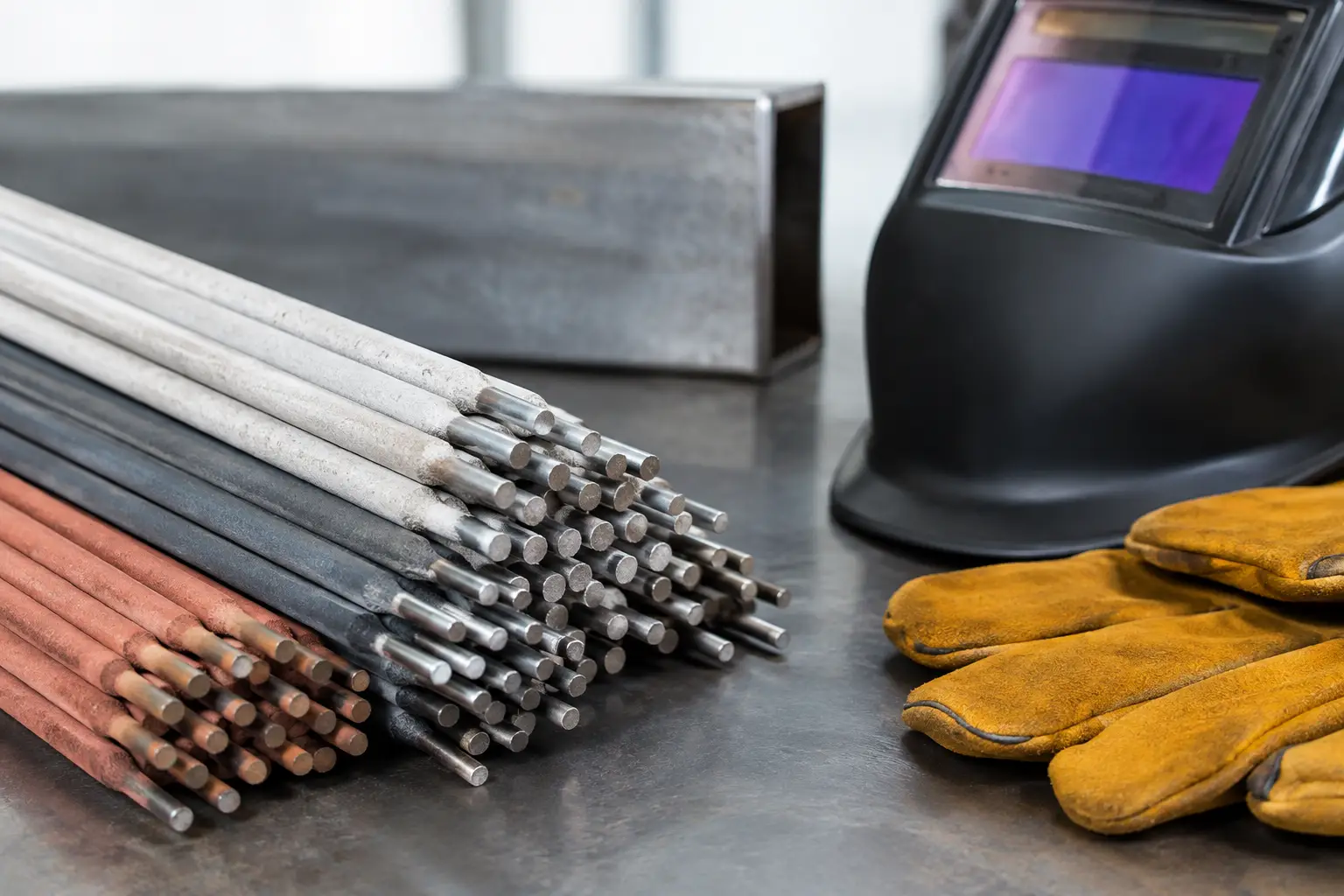
A welding electrode that strikes easily but is wrong for the steel, joint or service conditions can create expensive problems long after the job leaves the workshop. Cracking, poor fusion, excessive spatter and failed inspection often begin with an unsuitable consumable. Effective welding electrode selection means matching the electrode to the whole application, not simply choosing the rod most familiar to the welder.
For procurement teams, supervisors and welding contractors, this is a practical control point. The correct electrode supports consistent weld quality, realistic production rates and safer working practices. It also helps standardise consumable stock across sites without forcing every task into a one-size-fits-all solution.
Start with the parent metal and required weld properties
The parent material is the first decision point. Mild steel fabrication may accept a broad range of general-purpose electrodes, while higher-strength steels, low-alloy grades, cast iron, stainless steel and hardfacing applications require more specific choices. Matching only the apparent strength of the material is not enough. Chemical composition, material thickness, restraint in the joint and expected operating conditions all affect the result.
For structural carbon steel, the deposited weld metal should generally meet the required tensile strength and ductility of the job. Where a component will experience vibration, impact, changing temperatures or cyclic loading, toughness and crack resistance may matter as much as tensile strength. A stronger electrode is not automatically the better electrode. An overmatched weld deposit can reduce ductility or introduce stresses that are unsuitable for the application.
When the steel grade is unknown, particularly on repair work, avoid assumptions. Identify the material where possible, review the approved welding procedure and use testing or competent technical advice before selecting a consumable. This is especially important for old plant, pressure-related work and critical structural repairs.
Read electrode classifications as a working specification
Electrode markings provide useful information, but they should be read alongside the manufacturer’s data sheet and the applicable welding procedure specification. In common classifications, the first figures generally indicate minimum tensile strength, while later figures refer to welding position and coating or current characteristics.
For example, E6013 electrodes are widely used for general fabrication because they offer easy arc starting, a smooth bead appearance and straightforward slag removal. They can be a sensible option for routine mild-steel work where the joint is clean and the duty is not highly demanding. Their convenience, however, does not make them the preferred answer for every structural or restrained joint.
Low-hydrogen electrodes such as E7018 are often specified where improved mechanical properties and reduced risk of hydrogen cracking are required. They are commonly used in structural fabrication and heavier sections, but their performance depends on correct storage and handling. If low-hydrogen electrodes absorb moisture, the benefit can be lost. Follow the manufacturer’s requirements for unopened packaging, rebaking where permitted, and holding temperature in suitable electrode ovens.
Cellulosic electrodes may suit certain root-pass and pipe-welding applications because of their penetrating arc and fast-freezing slag. They require the right technique and power-source compatibility, so they should be selected for a defined procedure rather than as a general workshop substitute.
Match the electrode to the joint and welding position
Joint preparation determines how much penetration, deposition rate and positional control are needed. A flat fillet weld on clean plate allows more choice than an open-root butt joint, an overhead repair or a vertical-up structural weld.
The electrode must suit the welding position. Some electrodes are intended for all-position welding, while others perform best in flat and horizontal work. Choosing an electrode with slow-freezing slag for overhead or vertical welding can make it difficult to control the weld pool, increase spatter and raise the chance of slag inclusions or lack of fusion.
Diameter matters too. Larger electrodes can deposit more weld metal in favourable positions, but they require more current and can be difficult to control on thin material, tight joints and positional work. Smaller diameters offer better control and are often more suitable for root passes or thinner sections, although they may reduce deposition rates. The efficient choice is the one that achieves the specified weld consistently, rather than the one that appears fastest on paper.
Consider the power source, polarity and site conditions
Before ordering electrodes in volume, confirm whether the available welding machines provide alternating current (AC), direct current (DC), or both. Certain electrode types are designed for particular polarity settings, and using the wrong setting can lead to unstable arcs, poor penetration and difficult slag control.
Site conditions also influence electrode performance. Outdoor welding may involve wind, uneven access, damp surfaces and variable power supply. Although stick welding is often more tolerant of outdoor work than gas-shielded processes, electrodes are not a remedy for poor preparation. Remove rust, paint, oil, moisture and other contaminants as far as the procedure allows. Protect the work area from weather where practical, particularly when moisture-sensitive consumables are being used.
For maintenance teams, access can be the deciding factor. A repair inside a plant frame or on a conveyor may demand a smaller electrode, a positional classification and a consumable suited to the available machine. This should still be checked against the required weld properties. Convenience must not override the approved procedure for safety-critical work.
Use a disciplined welding electrode selection process
A consistent process helps teams reduce guesswork and avoid holding unnecessary electrode types in stock. Before issuing electrodes, confirm these points:
- Parent metal grade, thickness and condition.
- Joint design, welding position and access restrictions.
- Required strength, toughness, corrosion resistance or wear resistance.
- Power-source type, polarity and available amperage.
- Welding procedure requirements, including preheat and post-weld treatment.
- Storage conditions and the need for low-hydrogen consumable control.
This information should be available to the welder at the point of work, not held only in a procurement file. The weld procedure, consumable batch records and inspection requirements should form part of the job pack where traceability is required.
Storage is part of electrode performance
Consumables can be correctly specified and still fail because they have been poorly stored. Damaged flux coatings, mixed electrode batches and exposure to humidity can affect arc stability and weld integrity. Low-hydrogen electrodes deserve particular attention, but all electrodes benefit from clean, dry, clearly labelled storage.
Keep electrode types separated and retain labels until the pack is fully used. This prevents a common workshop error: placing unused rods back into the wrong container. For controlled work, record batch or lot details as required by the welding procedure and quality system. Procurement teams can support this by ordering practical pack sizes and ensuring electrode ovens, quivers and dry storage are available where the work takes place.
Connect consumable choice with welder safety
The electrode is only one part of a safe welding system, but it affects the conditions around the weld. Arc behaviour, spatter, slag and fume generation vary by electrode type, material and technique. The correct consumable should therefore be supported by suitable welding PPE and engineering controls.
Welders need appropriately rated helmets or face shields, flame-resistant clothing, gloves, safety footwear and hearing protection where noise exposure requires it. Respiratory protection must be selected according to the fume risk assessment and used with appropriate local extraction or ventilation. Stainless steel and coated materials can present additional fume hazards, while confined or enclosed spaces require a more controlled approach.
Good electrode handling also reduces burn and fire risk. Keep hot work areas clear of flammable materials, use insulated electrode holders in sound condition and provide suitable fire-watch arrangements where required. A dependable supply of electrodes, protective equipment and welding accessories makes it easier for supervisors to maintain these controls without delaying the job.
Avoid the common shortcuts
The most frequent shortcut is selecting the same general-purpose electrode for every carbon-steel task. This may appear to simplify purchasing, yet it can create rework when a joint needs low-hydrogen properties, deeper penetration or reliable positional performance. Another error is substituting an electrode because it is available, without confirming equivalence against the procedure.
Do not judge electrode suitability by bead appearance alone. A neat surface can conceal inadequate fusion, incorrect mechanical properties or hydrogen-related cracking. Where weld quality is critical, use approved procedures, qualified welders and the appropriate inspection method for the work.
A well-chosen electrode gives the welder a controllable arc and gives the business greater confidence in the finished job. Build the decision around the material, joint, procedure and workplace conditions, then keep the selected consumable protected and clearly controlled until it is used.