

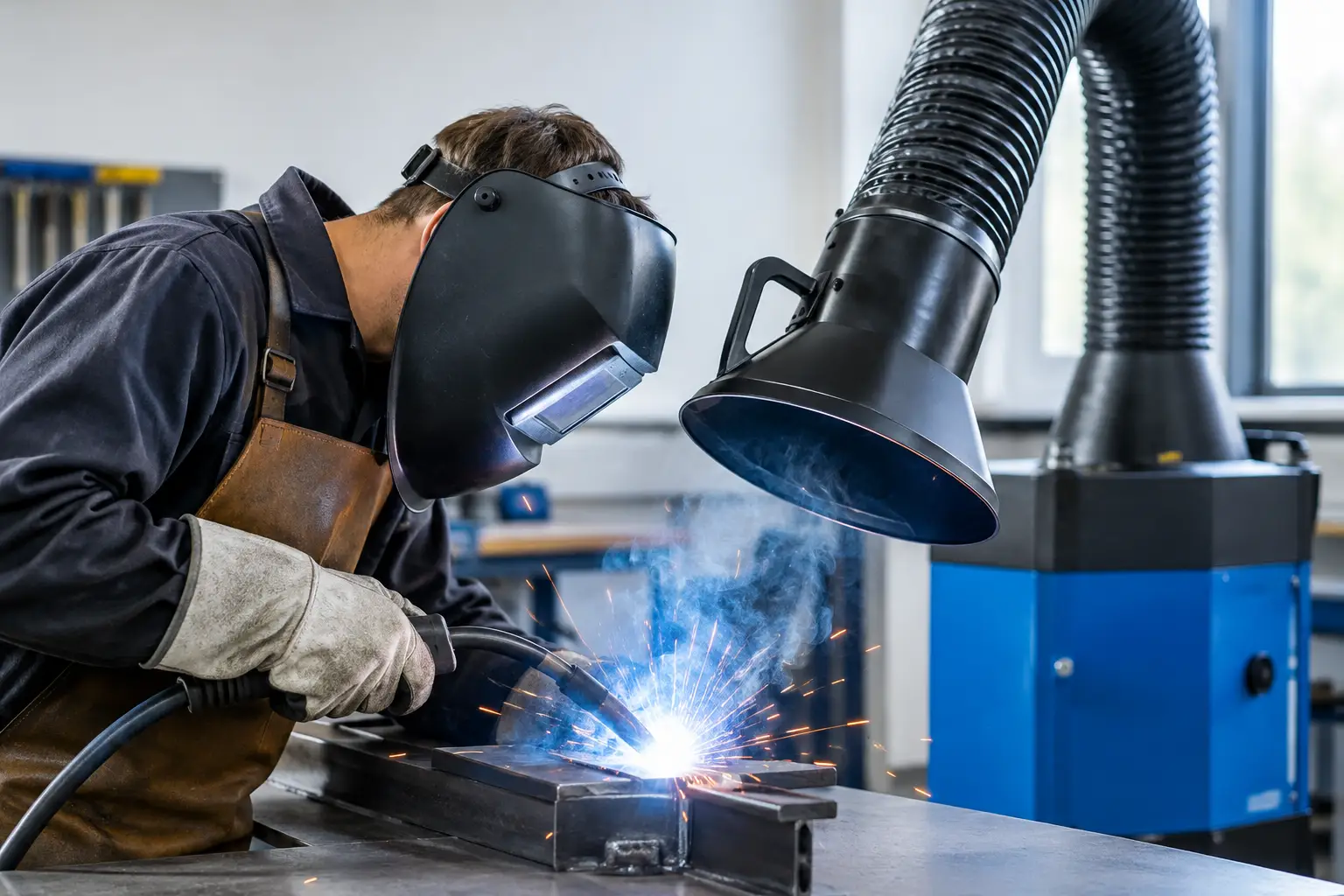
A welding bay can look clean while the air around the welder tells a different story. The visible plume from an arc is only part of the exposure. Welding fume extraction is the practical control that captures contaminants close to their source, before they spread through the workshop, settle on surfaces or enter a worker’s breathing zone.
For safety officers, workshop managers and procurement teams, the objective is not simply to buy an extraction unit. It is to create a workable system that protects people without obstructing access, slowing production or becoming another item that is ignored when the job gets busy.
Why welding fumes need active control
Welding produces a complex mix of fine metal particles and gases. Its composition changes with the process, base material, filler metal, coatings and consumables in use. Mild-steel welding, stainless steel fabrication, galvanised components and painted surfaces do not present the same exposure profile. Stainless steel and certain alloys, for example, can generate fumes containing chromium and nickel compounds, while welding on galvanised steel can release zinc oxide fume.
The smallest particles are a particular concern because they can remain airborne for long periods and be inhaled deeply into the lungs. Acute effects may include eye, nose and throat irritation, headaches and flu-like symptoms. Longer-term exposure can contribute to serious respiratory ill health. Gases generated during welding can also displace oxygen or irritate the respiratory system, particularly in enclosed or poorly ventilated work areas.
General workshop ventilation has a role, but it is rarely enough on its own. Opening roller doors or fitting roof extractors may reduce the overall haze in a building, yet it does not reliably capture fume at the point where the welder is breathing it. Local exhaust ventilation is designed to address that gap.
Welding fume extraction starts at the source
Effective welding fume extraction works on a simple principle: capture the fume as close as possible to where it is created. That normally means positioning a capture hood, extraction arm, downdraught bench or on-torch extraction system so the airflow draws the plume away from the welder.
The best choice depends on the work. A fixed fabrication station with repeat jobs may suit an extraction arm or a purpose-designed welding bench. A team working on large frames, vessels or machinery needs a solution that can move with the job, such as a portable extractor with flexible arms or a high-vacuum system. Where welding positions change constantly, on-torch extraction can be highly effective because the capture point follows the arc.
Each approach involves trade-offs. A large extraction arm can cover a useful area, but only if the operator can position it correctly and keep it close enough to the plume. Portable units offer flexibility but must have adequate extraction capacity for the process and be placed so that hoses do not create a trip hazard. On-torch systems reduce reliance on operator positioning, although they can add weight and require suitable torches, consumables and maintenance.
The right system should support the actual job, not an idealised version of it. Observe the work before specifying equipment. Consider component size, welding position, arc time, the number of simultaneous welders, available floor space and whether the work is repetitive or variable. These details determine whether extraction becomes part of the process or is left unused in a corner.
Capture distance matters
Even a well-specified extractor performs poorly when its hood is too far from the arc. Airflow weakens quickly as the capture point moves away from the source. The operator should be able to place the hood close enough to capture fume without blocking visibility, restricting hand movement or drawing shielding gas away from the weld.
This calls for practical training, not just installation. Welders need to understand where the fume travels, how to reposition an arm during a job and why a hood placed behind the plume cannot provide effective control. Supervisors should also check that extraction remains in use during short tasks, rework and awkward-position welding, which are often the moments when controls are bypassed.
Selecting equipment for the workshop environment
Procurement decisions should be based on the application and the contaminant, rather than price alone. An extractor must be suitable for the welding process and materials being used, and its filter arrangement must match the type and volume of fume generated. Filtration performance, airflow, duty cycle, noise levels, mobility and available power supply all need consideration.
A useful assessment should cover four operational questions:
- What welding processes and materials are used, including coated, galvanised or stainless steel?
- How many welders will operate at the same time, and for how many hours per shift?
- Is the work completed at fixed stations, across a large fabrication area or at customer sites?
- Can the unit be maintained safely and consistently, including filter changes and waste disposal?
For some applications, a central extraction system may be justified. It can serve several fixed welding bays and reduce the number of standalone units on the floor. However, it requires careful system design, installation planning and ongoing inspection. For smaller workshops or mixed-site work, portable extraction equipment can offer better value and flexibility.
Do not overlook the workspace itself. Welding in a confined space, inside a tank, near pits or in areas with limited air movement needs a task-specific risk assessment. Standard portable extraction may not provide sufficient protection in these conditions. Additional ventilation, atmospheric monitoring, permit controls and appropriate respiratory protection may be required.
Extraction and PPE work together
Respiratory protective equipment is an important part of welder protection, but it should not be treated as a substitute for effective extraction. A properly selected respirator protects the individual wearer; local extraction reduces contaminants in the shared work environment and limits exposure for nearby employees.
This is especially relevant where other trades work near welding operations, or where supervisors, inspectors and material handlers move through the same space. Screens can control arc flash and help contain sparks, but they do not remove airborne fume. Good workshop control usually combines extraction, sensible layout, welding screens, housekeeping and correctly selected PPE.
Welders may require suitable eye and face protection, flame-resistant workwear, welding gloves, hearing protection and safety footwear alongside respiratory protection. The exact PPE selection depends on the process and risk assessment. Fit testing, correct storage and replacement schedules matter where tight-fitting respiratory equipment is used. A facepiece that is worn incorrectly, damaged or incompatible with facial hair cannot provide the expected protection.
Maintenance is part of the control measure
Extraction equipment only protects people when it is working as intended. Blocked filters, damaged hoses, poorly positioned arms and full dust containers can all reduce performance. The warning signs are often visible: fume lingering around the welder, dust escaping from the unit, unusual noise, weak suction or operators moving hoods aside because they are difficult to use.
Build routine checks into workshop operations. Operators can inspect hoses, nozzles and extraction arms before use, while responsible maintenance personnel should check airflow indicators, seals, filter condition and electrical components at planned intervals. Filters must be replaced in accordance with the equipment requirements and disposed of safely, taking account of the materials being welded.
Records are equally useful. A simple inspection and service log gives safety teams evidence that the control has been checked, helps identify recurring faults and supports planned replacement rather than emergency purchasing. It also makes it easier to compare equipment performance across multiple sites or departments.
Make the system easy to use
The strongest fume-control plan is one that welders can apply without disrupting a productive shift. Place equipment where work happens, provide enough extraction capacity for busy periods and involve experienced welders when deciding on arm positions, bench layouts and portable-unit locations. Their feedback will quickly expose a design that looks good on paper but creates access problems in practice.
GHS Health & Safety CC supports organisations with dependable welding equipment, PPE and workplace safety products selected around real operating requirements. A coordinated approach helps procurement teams protect workers, maintain consistency across sites and avoid the cost of piecemeal safety buying.
When reviewing a welding area, start with the plume rather than the catalogue. Watch where the fume rises, where the welder stands and how the job changes through the shift. That practical observation is often the clearest route to extraction that is used properly and performs when it matters most.