

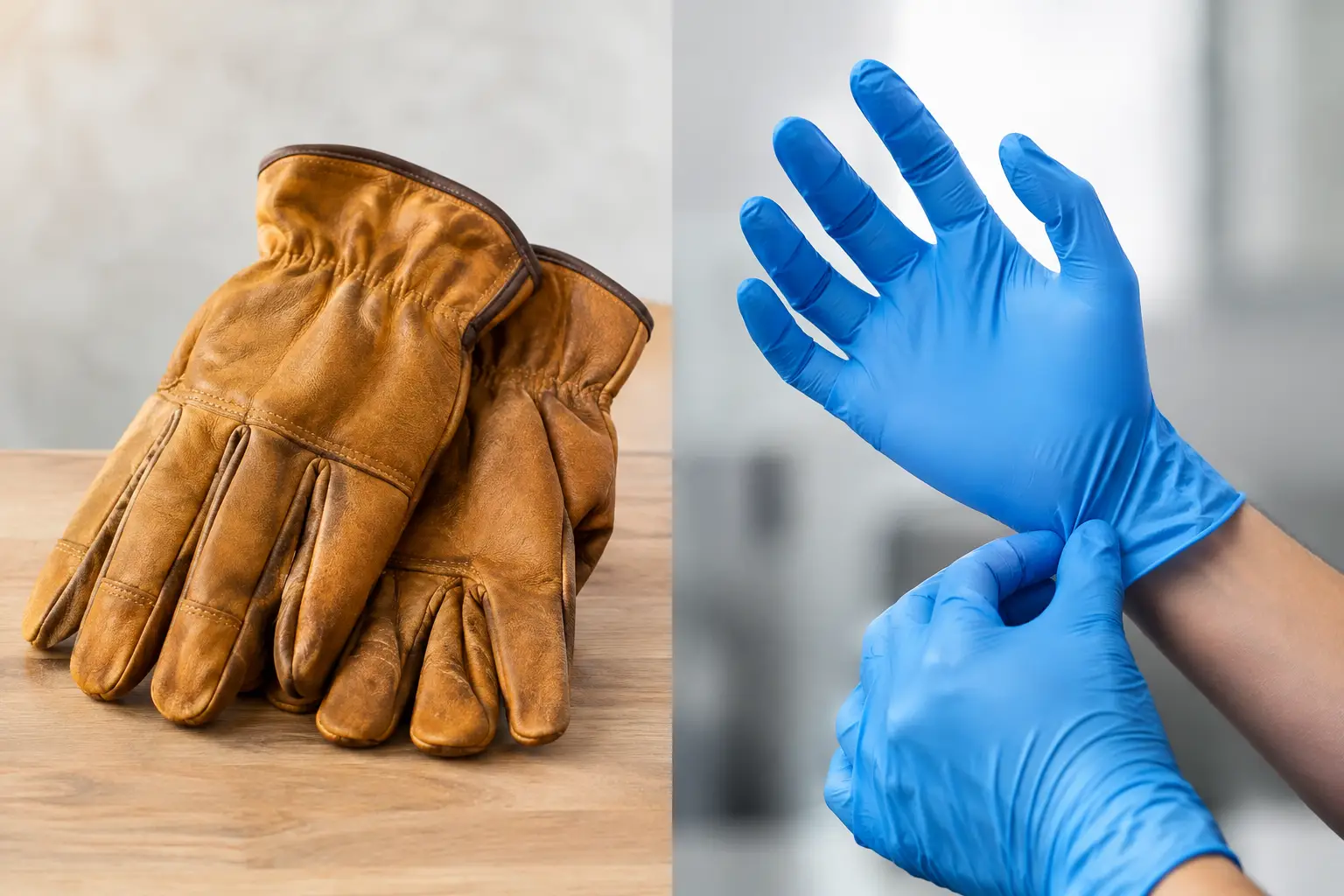
A welder clearing hot steel, a fitter handling oily components and a cleaner decanting chemicals may all ask for “work gloves”. Yet leather versus nitrile gloves is not a choice between a premium and budget option. They protect against different hazards, perform differently once wet or contaminated, and place different demands on procurement, training and replacement schedules.
The right decision starts with the task, not the glove material. Hand protection should allow people to work with confidence while reducing the actual exposure present in the job. A glove that lasts well but removes too much dexterity can create a handling risk. One that feels light and comfortable but is unsuitable for heat, abrasion or chemicals can leave workers exposed.
Leather versus nitrile gloves: the essential difference
Leather gloves are generally selected for mechanical work involving abrasion, rough surfaces, sparks, moderate contact heat and robust material handling. They are a familiar choice in construction, fabrication, welding, rigging, maintenance, landscaping and general site work. Quality matters: the cut, thickness, stitching, cuff length and leather type all affect how a glove performs.
Nitrile gloves come in two common forms with very different uses. Disposable nitrile gloves are thin, single-use gloves for contamination control, light chemical splash protection and tasks requiring close hand feel. Nitrile-coated work gloves have a fabric liner with a nitrile coating on the palm or throughout the glove. They are designed for grip, abrasion resistance and handling oily or damp parts.
This distinction is essential for buyers. A disposable nitrile glove is not a substitute for a coated mechanical glove, and a nitrile-coated glove is not automatically suitable for the chemical being handled. The product specification and intended application must guide the issue decision.
Where leather gloves perform best
Leather is valued because it combines durability with a degree of natural comfort. It stands up well to friction from coarse materials, timber, steel, wire and equipment surfaces. In welding, leather gloves also provide a useful barrier against sparks and spatter, particularly when a longer gauntlet cuff protects the wrist and lower forearm.
Different leathers suit different jobs. Cowhide is widely used for durable general-purpose and welding gloves. Goatskin is often preferred where a softer feel and better dexterity are needed, such as TIG welding or detailed handling. Split leather offers economical, hard-wearing protection for heavier applications, while grain leather is generally smoother and more dexterous.
Leather is also a sensible choice where workers repeatedly handle hot-but-not-extreme-temperature items, provided the glove is rated and specified for the exposure. Heat resistance is not simply a property of any leather glove. The duration of contact, temperature, glove construction and internal lining all matter. A glove that protects against brief spark contact may not protect against sustained contact with hot metal.
There are limits. Leather absorbs moisture and can become heavy, stiff or less comfortable when wet. It is not appropriate for liquid chemical handling, and contamination can be difficult to remove. Leather gloves can also reduce fine finger control, especially thicker welding styles. For precision assembly, small fasteners or prolonged work with oily components, a nitrile-coated alternative may be more productive.
When nitrile is the stronger choice
Disposable nitrile gloves are commonly used in cleaning, laboratories, healthcare-adjacent environments, food-related handling, inspection, painting preparation and maintenance tasks involving oils, greases or cleaning agents. They offer good tactile sensitivity and are latex-free, which helps organisations reduce concerns around natural rubber latex sensitivity.
Their resistance to puncture and many chemicals is often better than that of standard latex gloves, but “nitrile” does not mean universal chemical protection. Chemical permeation depends on the exact substance, its concentration, temperature, contact time and glove thickness. A thin examination glove may be suitable for incidental splash exposure but unsuitable for immersion or extended handling. Safety officers should check the manufacturer’s chemical-resistance data for the specific product and substance before approving a glove.
Nitrile-coated gloves are particularly useful in warehousing, automotive work, assembly, engineering, logistics and maintenance. The coating helps users hold oily parts and tools more securely than leather often can. A breathable knitted liner can also improve comfort during repetitive work, while a close fit supports dexterity.
However, coating coverage makes a difference. A palm-coated glove may keep the back of the hand cooler, but it does not provide the same liquid barrier as a fully coated style. Nitrile-coated gloves are also not welding gloves. The fabric liner and coating can be damaged by sparks, heat or molten metal, so welding and hot-work teams need purpose-designed leather protection.
Match the glove to the real hazard
The most reliable procurement process is to observe the task as it is performed. Ask what workers touch, how long they hold it, whether it is dry or oily, whether sharp edges are present, and whether heat, chemicals or contamination are involved. Also consider whether the task changes during a shift. A maintenance technician may need different gloves for machine repair, solvent cleaning and general handling.
For most organisations, a glove programme requires more than one option. A fabrication workshop may issue leather welding gauntlets for welding, cut-resistant gloves for sharp sheet handling, and nitrile-coated gloves for assembly and moving oily components. This is not overcomplication. It is hazard-specific PPE selection.
The following factors should be considered together when comparing gloves:
- Mechanical risks: Abrasion, tearing, puncture and cut exposure require different levels of protection. Do not assume a thick glove has adequate cut resistance.
- Heat and flame exposure: Choose gloves purpose-designed for welding, hot work or contact heat, with suitable cuff length and construction.
- Chemical exposure: Confirm compatibility against the actual chemical rather than relying on material descriptions alone.
- Grip and dexterity: Fine assembly and powered-tool work demand secure grip and enough finger movement to operate controls safely.
- Comfort and fit: Gloves that are too large, too hot or difficult to work in are more likely to be removed or misused.
- Replacement frequency: A lower unit price can become costly if gloves fail early, while an over-specified glove can waste budget where a lighter style is sufficient.
Durability, cost and stock control
Leather gloves usually have a longer usable life in dry, abrasive work, especially when workers are trained to store them away from moisture, chemicals and excessive heat. Their higher initial cost can be justified where a glove is used repeatedly over demanding shifts. Inspection remains necessary. Worn stitching, hardened leather, holes, embedded metal fragments and chemical contamination are all reasons to replace gloves.
Disposable nitrile gloves are consumed quickly by design. Their value lies in hygiene, convenience and the ability to change gloves between tasks or when contamination occurs. Procurement teams should estimate usage realistically, including changes after breaks, damage and task transitions. Under-ordering can lead to workers stretching gloves beyond their intended use or substituting unsuitable stock.
Nitrile-coated gloves sit between these two models. They are reusable, but their service life depends on coating wear, laundering practices where permitted, and exposure to oils or solvents. Stocking a small range of clearly differentiated styles can simplify issue control: one glove for dry handling, one for oily grip, one for welding, and approved disposable nitrile options for cleaning or contamination-sensitive work.
Fit, training and supervision matter
Even a correctly specified glove fails if it does not fit. Staff should have access to appropriate sizes, including smaller and larger options. Loose fingertips reduce control and can catch on workpieces; overly tight gloves cause fatigue and may tear prematurely. Workers should also understand that gloves are not always safe around rotating machinery. Where there is an entanglement risk, the safe system of work may require hands to remain ungloved near moving parts.
Brief toolbox talks can improve glove use substantially. Explain which glove is for which task, where gloves are stored, when they must be replaced, and why contaminated leather gloves must not be used for general work. Supervisors can then identify recurring failures that point to a poor product match rather than worker misuse.
GHS Health & Safety CC can help organisations compare hand-protection options across routine handling, welding, chemical-use and specialist applications, supporting a practical selection based on the conditions on site.
The best glove is the one workers can wear comfortably for the full task while it protects against the hazard actually in front of them. Review glove choices on the workshop floor, not only on a catalogue page: the marks, moisture, heat and handling demands seen during a normal shift will usually make the correct choice clear.