

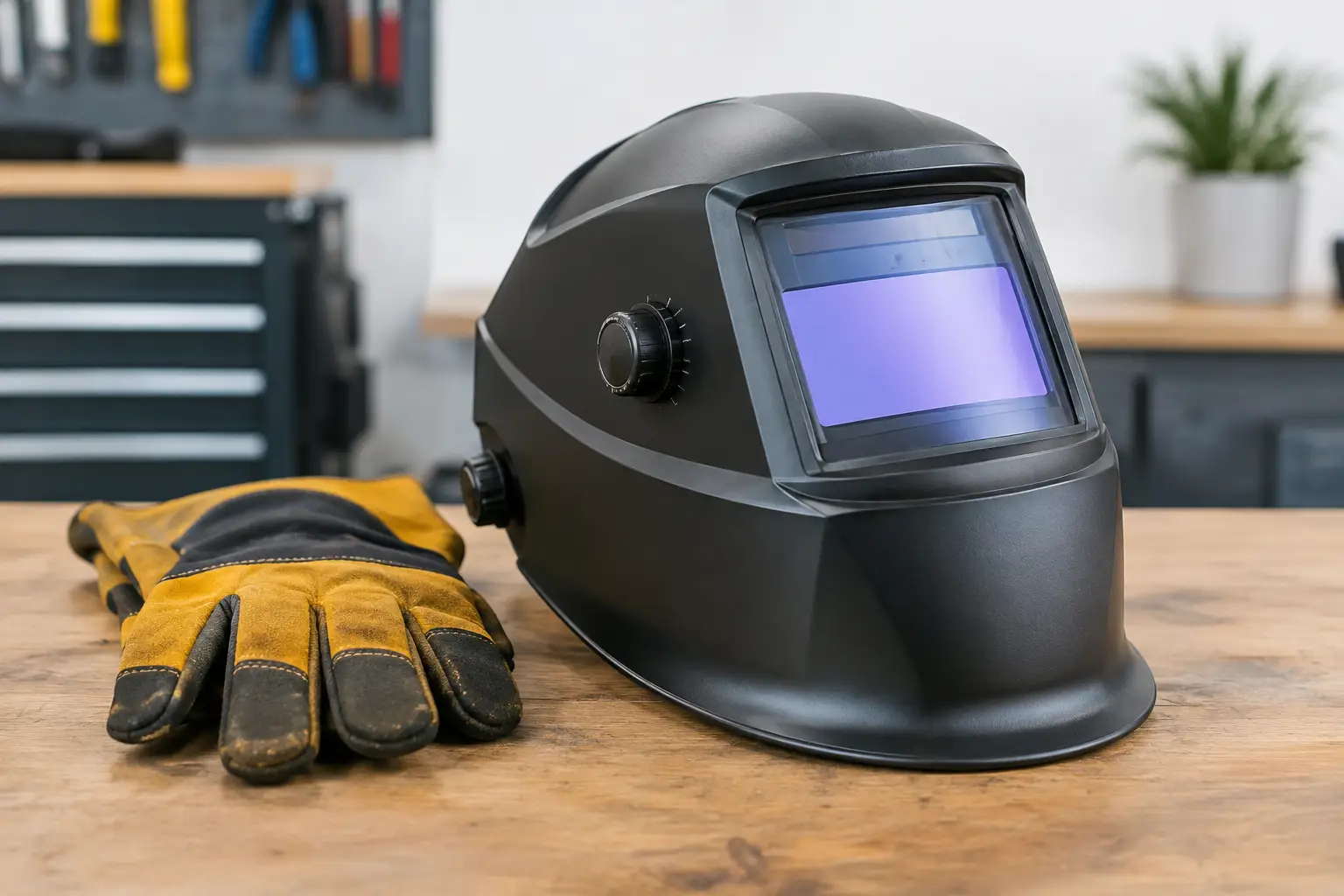
A welding helmet that reacts too slowly, fits poorly or provides the wrong shade can interrupt work and expose the welder to avoidable risk. This auto darkening welding helmet guide helps procurement teams, supervisors and welders specify protection that suits the process, working environment and frequency of use.
Auto-darkening helmets can improve visibility before and after the arc starts, helping operators position the torch or electrode accurately without repeatedly lifting the visor. That practical advantage only delivers value when the lens, shell, adjustment range and supporting PPE are matched to the task.
Start with the welding process and risk assessment
The correct helmet depends on more than a preferred brand or a headline shade range. Consider the welding method, expected amperage, working position, duration of exposure and the presence of nearby welders. MIG, TIG, MMA and plasma cutting can each place different demands on the filter and its settings.
A welder carrying out intermittent fabrication in a well-lit workshop may need a different specification from a pipe welder working overhead, a maintenance team member moving between grinding and welding, or a production operator completing repeated welds throughout a shift. Confined spaces, outdoor work and reflective surfaces also affect visibility and comfort.
The helmet must be part of a wider PPE selection. Welding gloves, flame-resistant workwear, safety footwear and suitable respiratory protection may all be required by the risk assessment. A welding helmet protects the face and eyes from arc radiation, sparks and spatter, but it does not replace safety spectacles. Approved eye protection should still be worn underneath where the task requires it.
Auto darkening welding helmet guide: key filter features
An auto-darkening filter cartridge has a light state for setup and a dark state that activates when its sensors detect an arc. This allows the operator to see the joint clearly before welding begins. The specification of that filter determines whether the helmet supports accurate, comfortable work or becomes a source of frustration.
Shade range and shade control
Shade refers to the darkness of the viewing filter during welding. A fixed-shade auto-darkening helmet may be suitable where teams perform a consistent process within a narrow amperage range. A variable-shade helmet offers more flexibility for mixed fabrication, maintenance work and contractors handling different jobs during the week.
Select the dark shade range according to the welding process and current being used. Very low-current TIG welding often benefits from a helmet with reliable low-amperage arc detection and sensitive adjustment. Higher-amperage welding and cutting may require darker settings. The manufacturer’s shade guidance should be checked against the task risk assessment rather than relying on habit or a setting used for another process.
A suitable light state is also useful. A clear light state makes it easier to inspect the workpiece, position consumables and move safely between tasks. It does not remove the need to use the helmet correctly whenever arc exposure is possible.
Sensors, sensitivity and response time
Most filters use two or four arc sensors. Two sensors can be effective for straightforward welding where the sensors have a clear view of the arc. Four sensors provide additional coverage and can be a better choice for complex positions, obstructed views, production work or situations where a hand, workpiece or fixture may partially block a sensor.
Sensitivity controls how readily the filter responds to the arc. This matters particularly for low-amperage TIG applications, where the arc can be less intense. Adjustable sensitivity can also help reduce unwanted activation from nearby welders or strong ambient light. The right setting depends on the environment, so operators should be trained to test and adjust it before work starts.
Switching speed is stated in fractions of a second. Faster response is generally desirable, but a purchase decision should consider the complete filter specification, certified performance and fit rather than a single number. A quality cartridge must darken consistently, not merely quickly under ideal conditions.
Delay, grind mode and viewing area
Delay control determines how long the filter remains dark after the arc stops. A short delay can suit short tacks and repetitive work. A longer delay can be more comfortable for higher-amperage applications where the weld pool remains bright after the arc ends. Adjustable delay gives experienced welders a useful degree of control.
A dedicated grind mode is valuable for teams that alternate between welding, chipping and grinding. It prevents unintended darkening while grinding and avoids the temptation to use a welding helmet as a general-purpose grinding visor without checking its suitability. A proper face shield may still be needed for certain grinding risks.
A larger viewing area improves peripheral vision and can make positional work easier, especially where welders need to monitor the joint, torch angle and surrounding hazards. The trade-off can be higher cost and, on some designs, additional weight. For occasional repair work, a standard window may be entirely appropriate. For full-shift fabrication, the improved sightline can support accuracy and reduce fatigue.
Do not overlook optical clarity and comfort
Optical classification describes how clearly and consistently the wearer sees through the auto-darkening filter. Filters may be rated for optical class, light diffusion, variation in luminous transmittance and angle dependence. A 1/1/1/1 classification represents the highest rating in each category and is often a strong choice for welders who spend long periods under the hood or carry out precision work.
Better optical clarity can reduce eye strain and support weld quality, but it must be weighed against the type of work and budget. Procurement decisions should focus on whole-life value: a helmet that improves comfort, reduces rework and remains dependable through regular use may be better value than a lower-priced option that operators avoid wearing.
Fit is equally operational. The headgear should adjust for head size, height, forward and rear position, and tilt. A balanced helmet stays in place when the wearer nods it down and should not create excessive pressure points across the forehead or crown. Check that controls are usable with gloves where relevant.
Compatibility deserves particular attention. If personnel wear prescription spectacles, hearing protection, hard hats or respiratory protective equipment, test the complete combination before placing a bulk order. A helmet that works well in isolation may interfere with another essential item of PPE. Where work includes overhead welding or substantial spatter exposure, consider shell coverage, neck protection and compatible flame-resistant garments.
Verify standards, durability and supply support
Choose helmets and filters from reputable manufacturers with clear technical information and certification. For many industrial welding applications, buyers will look for conformity to applicable standards such as EN 379 for automatic welding filters and EN 175 for equipment used for eye and face protection during welding. The exact requirement should be confirmed against the site risk assessment, client rules and applicable South African standards or project specifications.
The shell should be designed to withstand the expected heat, sparks and workshop handling. Look beyond the lens cartridge: inspect the hinge, headgear, sweatband, controls, lens retention and availability of replacement parts. Outer cover lenses are consumable items. If they are difficult to replace or routinely unavailable, a good helmet can quickly become poor value.
For organisations buying for several sites or crews, standardising a sensible range can simplify training, stockholding and replacement. It does not mean every welder needs the same model. A practical approach may be to specify a dependable general fabrication helmet, then select higher-sensitivity or larger-view alternatives for specialist TIG, pipe or high-volume production work.
Set up, inspect and maintain every helmet
A helmet should be checked before each shift or before use. Inspect the outer and inner cover lenses for scratches, pitting, cracks and weld spatter. Damage can obscure vision or reduce protection. Confirm that the filter activates correctly using the manufacturer’s test method, and ensure the battery or solar-assisted power system is functioning as intended.
Keep sensors and solar cells clean. Replace cover lenses promptly rather than asking welders to work through a damaged viewing window. Clean the shell and headgear with methods approved by the manufacturer, avoiding solvents that could damage plastics or seals. Store helmets in a dry, protected place away from crushing loads, extreme heat and direct workshop contamination.
Training should cover shade selection, sensitivity, delay settings, grind mode and routine inspection. Supervisors should also make clear that a helmet with a cracked shell, unreliable filter or severely scratched lens is not acceptable for continued use. A simple defect-reporting and replacement process keeps production moving while protecting workers.
A buying decision that supports safer welding
The best auto-darkening welding helmet is the one that gives the operator dependable protection and a clear, stable view of the weld, while fitting the realities of the job. Specify it around the process, confirm compatibility with the wider PPE programme and plan for replacement lenses and parts from the outset. GHS Health & Safety can assist organisations in selecting welding protection that performs when it matters most, without adding unnecessary complexity to the purchasing process.
Give welders the opportunity to trial shortlisted helmets on real tasks before standardising. Their feedback on visibility, balance and adjustment will often reveal the difference between PPE that is issued and PPE that is consistently worn correctly.