

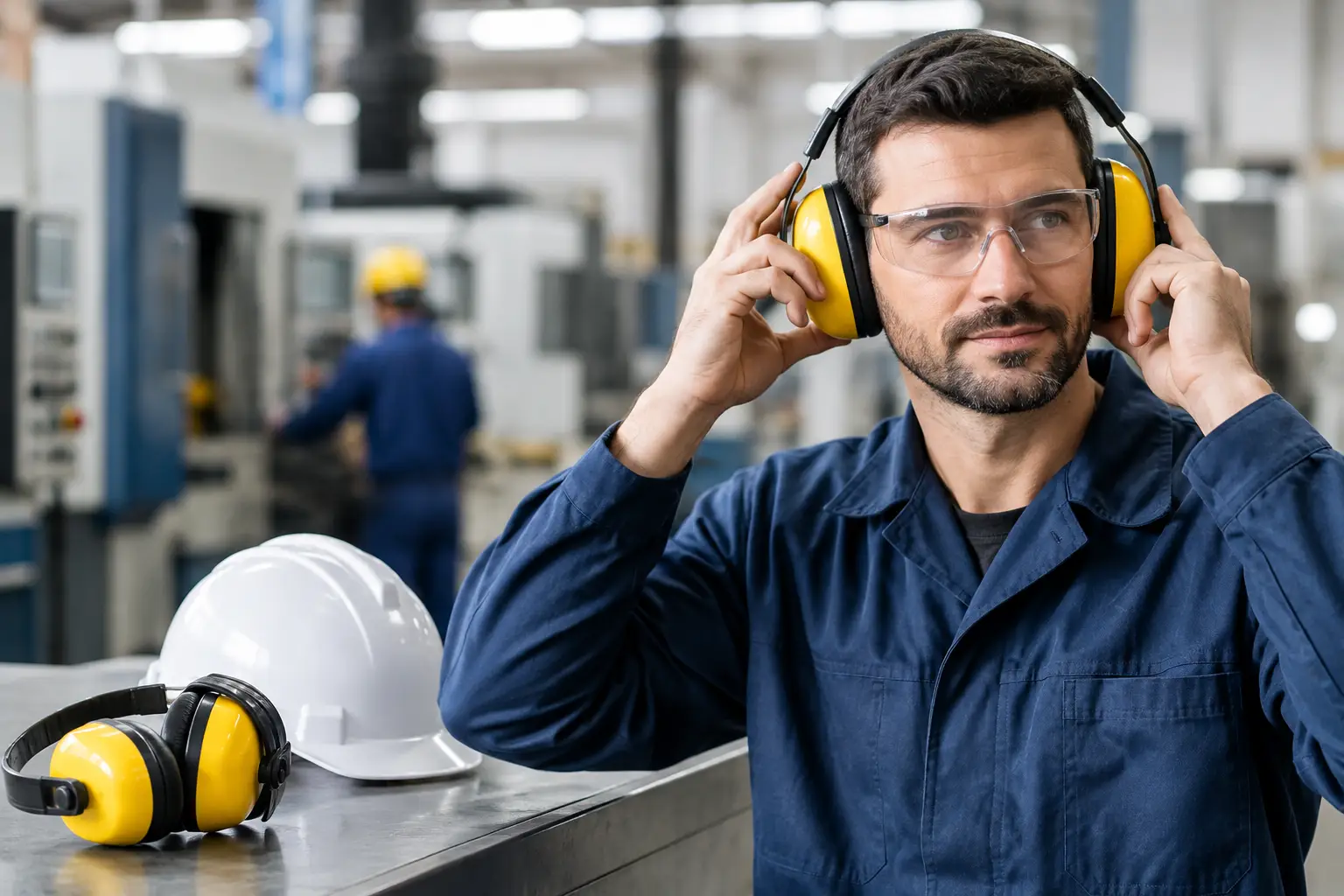
A press brake cycles, an air line hisses and a forklift reverses at the same time. None of these sounds may seem exceptional in isolation, but over a full shift they can create a serious exposure risk. Effective hearing protection for factory workers is therefore not simply a matter of issuing earplugs at the stores counter. It requires the right product for the measured noise level, the job, the wearer and the rest of the PPE being used.
For operations and safety teams, the objective is practical: reduce harmful exposure without making work more difficult or isolating people from essential communication. A programme that workers can wear correctly throughout a shift is far more valuable than a high-rated product that remains in a pocket or is removed every time a conversation is needed.
Start with the real noise exposure
Factory noise is rarely uniform. The operator working beside a stamping press may face a very different exposure from a packer at the end of the same production line. Maintenance teams can move between quiet plant rooms and short, high-noise tasks, while forklift drivers need to hear warnings and instructions clearly. Selecting protection by department name alone can leave gaps.
Begin with a current noise assessment conducted across representative tasks, locations and shift patterns. It should consider average exposure over time as well as peak or impact noise. Record where the noise occurs, how long employees are exposed and whether temporary staff, contractors or visitors enter those areas. Production changes, new machinery and altered layouts can all change the risk profile, so an assessment should be reviewed rather than treated as a once-off exercise.
The assessment gives procurement teams a sound basis for specifying products. It also helps to identify where engineering controls, machine maintenance, acoustic guarding or altered work practices could reduce noise at source. Hearing protection is vital PPE, but it should sit within a wider control plan.
Choosing hearing protection for factory workers
Hearing protection must provide sufficient attenuation without overprotecting the wearer. If noise is reduced too far, employees may struggle to hear alarms, vehicle movements, spoken instructions or changes in machine operation. This can create a different safety concern. Product performance figures are useful, but real-world protection also depends on fit, wear time and compatibility with other equipment.
Disposable and reusable earplugs
Earplugs are compact, cost-effective and convenient for many production environments. Disposable foam plugs can suit visitors, short-term workers and controlled issue programmes, provided they are inserted properly. Reusable plugs are a practical option where hygiene arrangements, storage and cleaning are well managed.
The trade-off is technique. Foam plugs need to be rolled, inserted deeply enough and held in place while they expand. A plug that sits only at the entrance of the ear canal offers far less protection than its rated performance suggests. Workers with dirty hands may also need access to clean plugs or appropriate hand-cleaning facilities before fitting them.
Earmuffs
Earmuffs are easier for supervisors to see and are often quicker for new users to fit correctly. They can be a good choice for intermittent exposure, because they can be put on and removed without touching the ear canal. Models fitted to safety helmets can be particularly useful where head protection is mandatory across the site.
However, the seal around the ear is critical. Spectacle arms, long hair, facial coverings, helmet straps and worn cushions can all compromise performance. Earmuffs can also feel warmer during long shifts, particularly in hot production areas. Comfort matters because even short periods without protection can significantly reduce the benefit gained over a shift.
Banded plugs and task-specific options
Banded earplugs can work well for employees who move regularly in and out of noisy zones, such as quality inspectors or maintenance personnel. They are not automatically the right answer for continuous exposure, but they make sense where frequent removal and refitting is unavoidable.
For complex environments, consider specialist options such as level-dependent electronic earmuffs. These can reduce harmful noise while allowing lower-level speech and warning sounds to remain audible. They require careful selection, training and battery management, but may be worthwhile where communication is central to safe work.
Fit is where protection succeeds or fails
A product approval mark and a high attenuation rating do not guarantee protection on the factory floor. The product must fit the individual wearer and be worn for the entire time they are exposed. This is why issue-only programmes routinely underperform.
Give workers practical instruction at the point of issue. Show them how to insert or position the protection, allow them to practise and check the result. Supervisors should know what a correctly fitted plug or properly seated earmuff looks like. Where available, individual fit testing provides a more reliable indication of whether selected protection is delivering adequate attenuation for each person.
Offer more than one suitable style where possible. Ear canal shape, skin sensitivity, hair, spectacles and personal comfort vary considerably. A worker who cannot tolerate a particular earplug during a 10-hour shift may simply remove it. Providing an approved alternative is often a better control than repeated enforcement of an unsuitable item.
Protect communication as well as hearing
Noise control cannot remove the need for communication. Production supervisors need to direct teams, banksmen need to manage vehicle movements and workers need to recognise alarms. Before standardising a hearing protection range, test it during real tasks rather than relying only on catalogue data.
Check whether workers can hear fire alarms, reversing warnings and abnormal machine sounds while wearing the selected product. Review hand signals, visual alerts and radio arrangements where speech is difficult. In noisy areas, clear signage and agreed communication methods reduce the temptation to lift earmuffs or remove plugs for a quick conversation.
Workers who rely on hearing aids need individual assessment and advice. The solution may involve compatible protection, adjusted work arrangements or specialist occupational health input. A one-size-fits-all instruction is not adequate.
Build hearing protection into routine procurement
Reliable availability matters as much as choosing the right product. If replacement plugs are unavailable at the start of a shift, or earmuff cushions are allowed to deteriorate, staff may improvise. Standardising a small, approved range makes it easier to maintain stock, train users and monitor compliance while still allowing for individual fit needs.
Procurement specifications should include the required protection level, relevant certification, compatibility with helmets and eye protection, hygiene requirements, replacement parts and expected working conditions. For example, a dusty fabrication shop, a food-processing environment and a hot foundry may each need different cleaning, storage and durability considerations.
GHS Health & Safety CC can assist organisations in matching recognised hearing protection products to wider PPE requirements, including head, eye, respiratory and face protection. This joined-up approach helps prevent one item from interfering with the fit or performance of another.
Inspection, cleaning and replacement
Hearing protection is not fit-and-forget equipment. Disposable plugs should be replaced after use in line with site hygiene procedures. Reusable plugs require cleaning and suitable storage. Earmuffs need regular inspection for cracked cups, hardened or split cushions, damaged headbands and weakened helmet attachments.
Set clear replacement triggers rather than waiting for total failure. A lost plug, contaminated reusable item or visibly damaged cushion should be replaced immediately. Keeping supplies close to entry points for designated noise areas makes correct behaviour easier at the moment it matters.
Supervisors can strengthen the programme through routine observation. The aim is not merely to catch non-compliance, but to ask why protection is not being worn correctly. The answer may reveal discomfort, poor availability, inadequate training, a communication problem or a change in the task.
When dual protection may be needed
In very high-noise environments or during short-duration peak-noise work, earplugs and earmuffs may be worn together. This should follow the findings of the noise assessment and the applicable workplace requirements. It is not simply a case of adding two published ratings together, as combined protection does not provide a straightforward mathematical total.
Dual protection also increases heat and communication challenges. Test the arrangement with the other PPE required for the task, particularly helmets, face shields and respiratory protection. The safest choice is the one that delivers suitable attenuation and can be worn correctly without conflict.
A well-run hearing protection programme is visible in everyday details: clean stock at the point of use, workers who know how to fit it, supervisors who address problems early and protection selected for the reality of the job. Those details preserve hearing long after the shift has ended.