

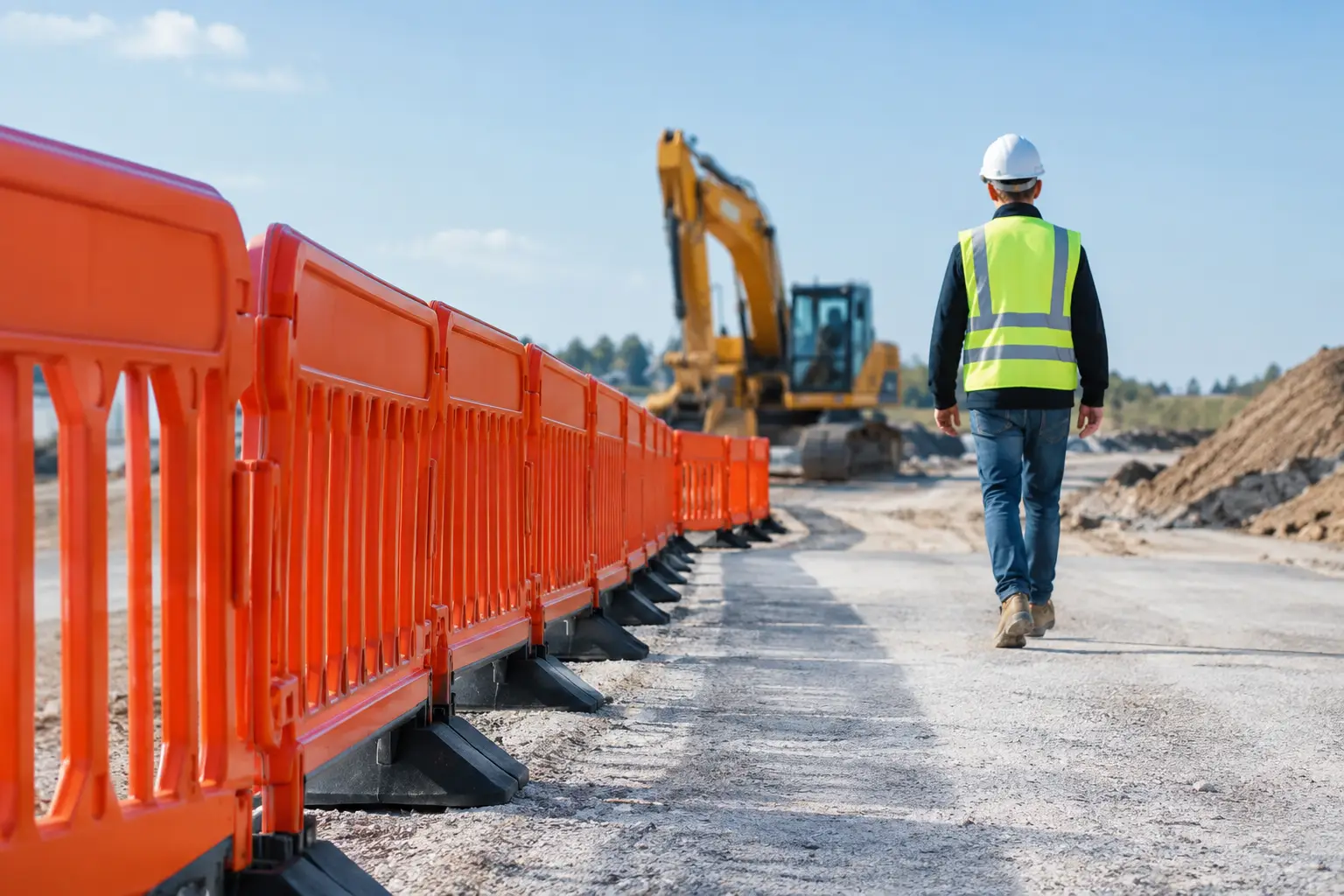
A loading bay changes character the moment a reversing vehicle arrives. A maintenance area becomes hazardous when a floor is opened, and a construction site can expose passers-by to risks they cannot see. Perimeter safety barriers create a clear physical boundary between people and hazards, helping organisations control access before an incident develops.
For safety officers, facilities managers and procurement teams, the task is not simply to place a few cones around a work area. The barrier must suit the hazard, remain visible in the working conditions, withstand the environment and direct people towards a safe route. The right choice supports safer movement, clearer site discipline and fewer interruptions to operations.
What perimeter safety barriers are designed to do
Perimeter barriers separate a restricted, hazardous or controlled area from pedestrian and vehicle traffic. They may be temporary, portable or fixed, depending on the site and the duration of the risk. Their purpose is to make a boundary unmistakable and difficult to cross accidentally.
In practice, barriers are used around excavation work, warehouse loading zones, temporary maintenance activities, chemical spill responses, events, roadworks, plant areas and construction perimeters. They can also guide visitors, contractors and employees along designated walkways where vehicles, forklifts or machinery are operating nearby.
A visible boundary does more than warn people. It gives supervisors a practical way to manage access, establish exclusion zones and keep work activities organised. When employees can immediately see where they may and may not go, they are less likely to enter an active work zone out of habit or convenience.
However, a barrier is not a substitute for proper planning. It should form part of a broader risk-control approach that may include signage, traffic management, trained marshals, lockout procedures, PPE and equipment guarding. The level of control required depends on the severity of the hazard and who could be exposed to it.
Choosing perimeter safety barriers for the real risk
The most suitable barrier depends on what it must prevent. A lightweight cone and chain arrangement may be appropriate for keeping pedestrians clear of a freshly cleaned floor. It is not suitable for stopping access to an open excavation or separating people from moving vehicles.
Start by considering the consequence of a breach. If someone passes through the boundary, could they encounter a minor trip hazard, a forklift route, high-voltage work or a fall from height? The greater the potential harm, the more substantial and controlled the barrier arrangement should be.
The following factors help procurement and safety teams select equipment with purpose rather than ordering a standard item for every site:
- Nature of the hazard: Determine whether the area involves vehicles, work at height, electrical work, suspended loads, chemicals, excavations or unauthorised entry.
- Required level of restraint: Decide whether the barrier only needs to guide people, provide a visual warning, delay access or physically prevent entry.
- Site conditions: Assess wind, rain, uneven ground, dust, UV exposure, night work and the likelihood of vehicle contact.
- Duration of use: A short maintenance task may need portable barriers, while a long-term construction boundary may require more durable fencing or fixed systems.
- Visibility needs: Consider high-visibility colours, reflective elements, warning signs and lighting where conditions are poor or shifts extend into darkness.
These decisions should be recorded in the relevant risk assessment or work method. Doing so gives teams a consistent basis for setting up barriers across different shifts and locations.
Temporary barriers for changing work areas
Temporary barriers are useful where hazards move or exist for a limited period. Safety cones, delineator posts, chain systems, barrier tape and folding pedestrian barriers can be deployed quickly and stored efficiently when not in use. They are common in warehouses, retail back-of-house areas, maintenance departments and facilities with frequent contractor activity.
Their main advantage is flexibility. A team can isolate a leaking pipe, cordon off a damaged section of flooring or redirect foot traffic while repairs take place. Yet flexible equipment also depends on disciplined use. Tape that sags, cones that are too widely spaced or a barrier positioned across an obvious shortcut can quickly lose its effect.
Where the risk is more serious, temporary fencing panels or water-filled barriers may provide a clearer and more stable perimeter. These options take longer to install, but they are better suited to extended construction activity, outdoor work and areas where public access must be managed carefully.
Fixed barriers for established hazards
Fixed barriers are generally appropriate where the hazard is permanent or repeated. They may protect racking ends, separate pedestrian walkways from forklift lanes, restrict access to machinery or define a secure operational boundary.
In these applications, the layout matters as much as the barrier itself. A pedestrian guardrail that ends before the crossing point can encourage people to step into a vehicle route without protection. Similarly, a fixed barrier that obstructs emergency access or blocks a safe evacuation route creates a different risk.
Consulting the people who use the area is worthwhile. Forklift operators, maintenance personnel, cleaners and shift supervisors can often identify shortcuts, bottlenecks and blind corners that are not evident on a site drawing. Their feedback helps ensure that barriers support productive movement rather than being bypassed.
Visibility and communication are part of the barrier
A physical boundary works best when people understand why it is there. Signs should describe the hazard or instruction clearly, such as “No unauthorised entry”, “Pedestrian route” or “Forklift operating area”. Vague notices are less useful when a visitor or contractor has not been briefed on the site.
Colour and contrast also influence how quickly a boundary is recognised. High-visibility yellow, orange and red are commonly used for temporary controls, while black and yellow markings are often used to draw attention to fixed hazards. There is no single colour arrangement that suits every application, so organisations should apply site standards consistently and align them with their signage and traffic-management procedures.
For low-light areas, reflective components, warning lamps or adequate task lighting may be needed. A barrier that is visible at midday but disappears during an early-morning shift does not provide reliable control. Check visibility from the approach direction, including the view from a forklift cab or delivery vehicle.
Installation, inspection and everyday control
Even high-quality equipment can fail when it is poorly positioned or left unchecked. Temporary barriers should be stable, connected where necessary and placed far enough from the hazard to give people a safe margin. For an excavation, for example, the boundary should not sit so close to the edge that a person can lean over it or dislodge material into the opening.
Site teams should inspect barriers at the start of a shift and after events that may affect them, such as strong wind, vehicle movements, rain or changes to the work scope. Look for damaged panels, missing signs, broken chains, faded markings, loose bases and gaps created by workers moving equipment through the perimeter.
Access points deserve particular attention. A controlled entry may need a gate, lock, attendant or permit system, depending on the task. If workers must repeatedly climb over or move a barrier to do their job, the setup is signalling a planning problem. A safer route or managed opening is normally required.
Clear ownership also prevents barriers from becoming abandoned site furniture. Assign responsibility for erection, inspection, adjustment and removal. Once the hazard has been eliminated, remove unnecessary barriers promptly so that employees continue to take active controls seriously.
Buying for reliability, not just unit price
For organisations purchasing safety equipment across multiple sites, standardisation can improve both control and cost management. Selecting a practical range of compatible cones, posts, chains, fencing panels, signs and pedestrian barriers makes replacement simpler and gives teams familiar equipment to use.
Price still matters, but the cheapest option may not deliver value if it cracks in outdoor conditions, lacks a stable base or needs frequent replacement. Consider material quality, expected service life, storage requirements and availability of matching components. A supplier that can support the wider safety requirement, from traffic controls to PPE and signage, can also reduce delays when an urgent site need arises.
GHS Health & Safety CC helps organisations source workplace safety products suited to different operating environments, with practical support for teams balancing compliance-minded protection, availability and budget control.
Perimeter controls are most effective when they make the safe choice the easy choice. Give people a boundary they can see, understand and trust, then maintain it with the same care given to the work taking place behind it.