

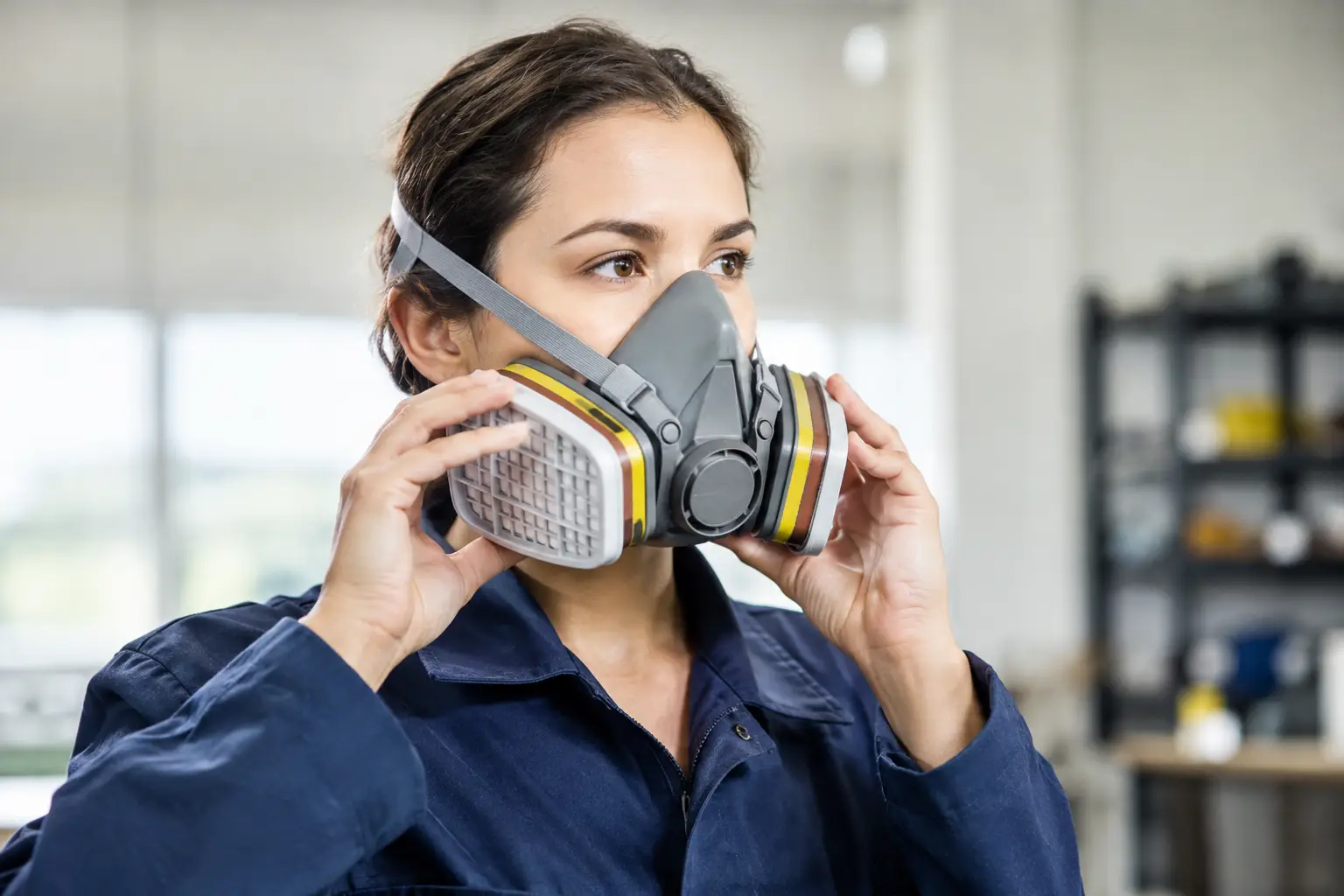
A respirator that is approved, correctly selected and poorly fitted can still leave a worker exposed. Gaps around the nose, cheeks or chin allow contaminated air to bypass the filter, which is why knowing how to fit a respirator is a practical workplace safety requirement, not simply an issue of comfort. For safety officers, supervisors and procurement teams, the objective is clear: ensure every wearer has equipment that matches the hazard, fits their face and can be used correctly throughout the task.
Start with the right respirator for the hazard
Fit comes after selection. Before issuing any disposable filtering facepiece, reusable half-mask, full-face respirator or powered system, assess what is in the air and how much exposure is expected. Dusts, nuisance particulates, welding fumes, mists, gases, vapours and oxygen-deficient atmospheres do not call for the same protection.
A particulate filter will not protect against solvent vapours, and an air-purifying respirator must not be used where oxygen levels are unsafe or where the atmosphere may be immediately dangerous to life or health. The work activity also matters. Grinding in a ventilated workshop, spray painting in an enclosed area and emergency response work all place very different demands on respiratory protection.
The chosen product must provide the required protection level and be compatible with the rest of the wearer’s PPE. Safety spectacles, hearing protection, welding helmets, hard hats and face shields should not disturb the face seal or pull the harness out of position. Procurement decisions based only on unit price often create avoidable problems when the respirator cannot be worn properly with the equipment already in use.
How to fit a respirator before entering the work area
The following process applies to tight-fitting disposable and reusable facepieces. Always follow the manufacturer’s instructions for the specific model, as strap layouts, nose clips and valve arrangements differ.
Check the condition and size
Inspect the respirator before use. On a reusable unit, check that the facepiece is clean, the valves lie flat, the straps are intact and the filters or cartridges are within their use-by date and correctly fitted. On a disposable respirator, check for damage, crushed edges, broken straps, tears and contamination. Do not issue a respirator that has been stored loose in a dirty vehicle, toolbox or work area.
Size is not a minor detail. A facepiece that is too large may leak around the chin and cheeks, while one that is too small may not cover the nose and chin properly. Where a model is available in more than one size, workers should have access to the size that has passed fit testing rather than being expected to make do with standard stock.
Position the facepiece correctly
Place the respirator over the nose and mouth, then draw it down under the chin. The sealing surface should sit directly against clean skin. For cup-shaped disposable respirators, position the lower edge firmly beneath the chin before tensioning the straps. For reusable half-masks, centre the facepiece so that it sits evenly across the nose and face.
Do not position a facepiece over a cap peak, hood edge, spectacles arm, hair or garment collar. These may look insignificant, but anything caught under the seal can create a leakage path.
Set and tighten the straps
For most disposable respirators with two straps, place the lower strap below the ears around the neck and the upper strap high on the back of the head. Straps should not cross, twist or sit over the ears. A reusable respirator normally has head harness straps that should be tightened evenly, beginning with the lower straps and then adjusting the upper straps.
Tightening harder is not the answer to every fit problem. Excessive tension can distort the facepiece, cause pressure points and make workers more likely to loosen or remove the respirator during a shift. The correct fit is firm and stable, with even contact around the seal.
Shape the nose clip where fitted
Use both hands to mould a metal nose clip around the bridge of the nose. Pinching it with one hand can leave uneven pressure and a channel for leakage. A nose clip helps achieve a good seal around the nose, but it cannot compensate for the wrong respirator size or facial hair in the sealing area.
Carry out a user seal check every time
A user seal check should be completed each time the respirator is put on, repositioned or disturbed. It is not a replacement for formal fit testing, but it confirms that the facepiece appears to be seated correctly at that moment.
For a negative-pressure check on many reusable respirators, cover the filter inlets or cartridges with the hands and gently inhale. The facepiece should pull slightly towards the face without obvious inward leaks. For a positive-pressure check, where the manufacturer permits it, cover the exhalation valve area and exhale gently. The wearer should feel slight pressure building inside the mask without air escaping around the seal.
Disposable respirators use model-specific methods, often involving covering the filter surface and breathing in or out. Follow the instructions supplied with that respirator. If air is felt around the nose, cheeks or chin, readjust the nose clip and straps, then repeat the check. If a seal cannot be achieved, the worker needs another size, model or type of respiratory protective equipment.
Facial hair, eyewear and other common barriers
Tight-fitting respirators require a clean-shaven sealing area. Beards, stubble, sideburns extending into the seal and even short growth can prevent the facepiece from sealing reliably. This is not a matter of appearance or preference. It is a protection issue that should be addressed in the company’s respiratory protection procedure before workers report for tasks requiring tight-fitting RPE.
Where an employee cannot shave for medical, cultural or religious reasons, a loose-fitting powered air respirator with an appropriate hood may be a suitable alternative, provided it is selected for the hazard and used within its specification. This should be assessed properly rather than relying on an unsuitable tight-fitting mask.
Spectacles can also affect a full-face respirator. Conventional spectacle arms usually pass through the seal and create leaks. Use compatible spectacle inserts where required. Workers should also report changes that can affect fit, including significant weight change, dental work, facial injury or surgery.
Fit testing proves the chosen model can work
A seal check is performed by the wearer. Fit testing is a formal assessment of whether a particular make, model, size and type of tight-fitting respirator seals adequately on that individual. It should be conducted by a competent person using an appropriate qualitative or quantitative method.
Qualitative fit testing uses a test agent that the wearer should not be able to taste or smell while wearing the respirator. It is commonly used for certain lower-protection tight-fitting facepieces. Quantitative fit testing uses an instrument to measure leakage and is generally required where higher protection levels or full-face respirators are involved. The appropriate method depends on the respirator and the level of protection required.
Fit testing should take place before first use and be repeated at planned intervals, when the respirator model changes or when changes in the wearer’s facial characteristics could affect the seal. Keep records of the exact respirator that passed, including manufacturer, model, size, filter configuration where relevant, test date and tester details. A pass on one model does not mean the wearer will pass on another.
Make correct use possible on every shift
Even a well-fitted respirator will fail as part of a safety programme if filters are not replaced, equipment is not cleaned or workers are not trained to recognise its limits. Reusable facepieces should be cleaned, dried and stored in a clean, sealed container away from direct sunlight, chemical contamination and crushing. Filters and cartridges need a documented replacement schedule based on the contaminant, concentration, use pattern and manufacturer guidance. Do not wait until a worker notices a smell or taste if the substance can break through without reliable warning.
Training should cover when respiratory protection is required, how to don and remove it without contaminating the face, how to perform a seal check, when to leave the area and how to report damage or breathing resistance. Supervisors should observe use in real conditions, particularly where heat, heavy physical work, welding helmets or confined spaces can make poor habits more likely.
GHS Health & Safety CC can support organisations in selecting dependable respiratory protection alongside the compatible PPE needed for the task. The strongest respiratory protection programme is built before the shift starts: select for the hazard, fit for the person, test the seal and give workers equipment they can rely on when conditions become demanding.