

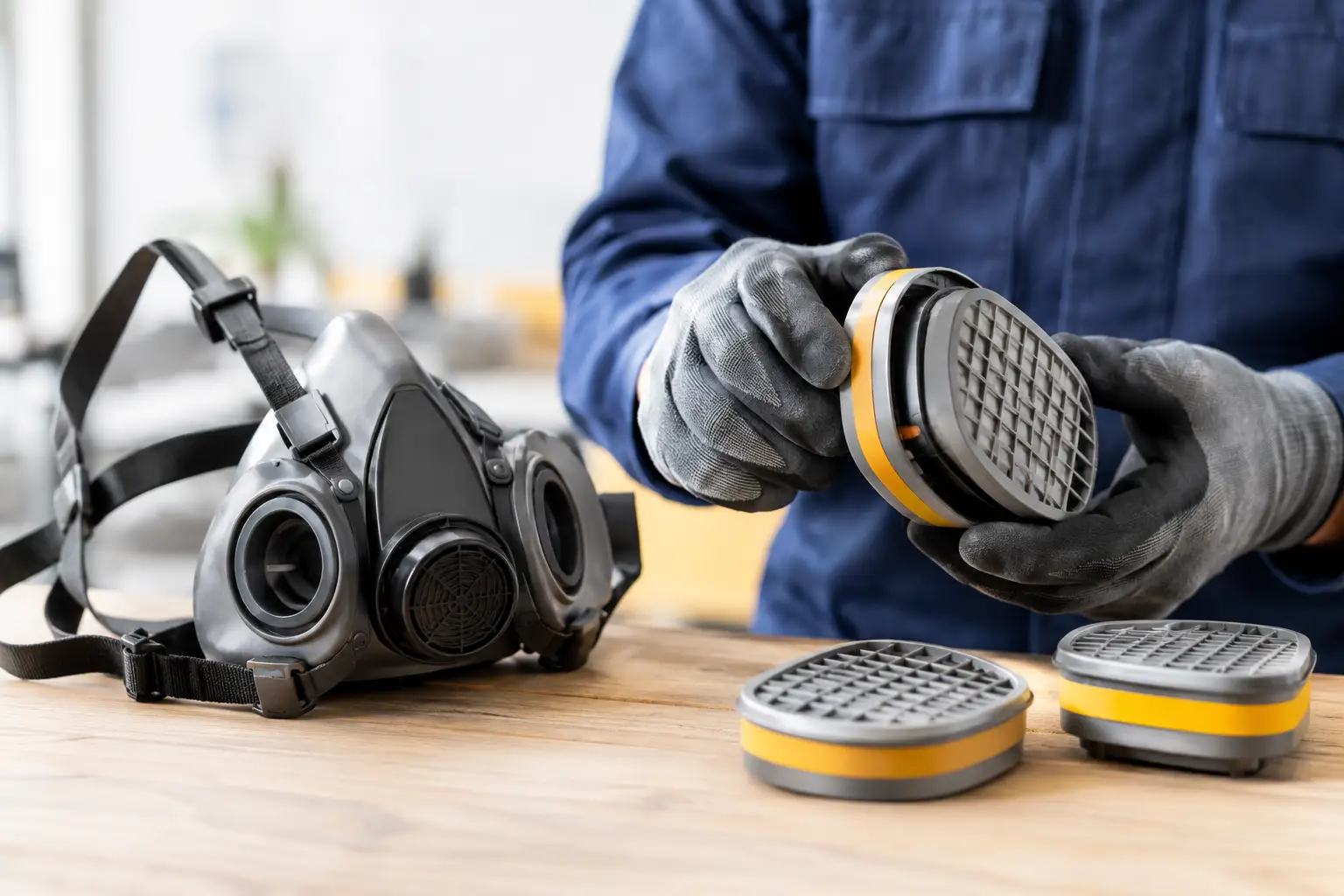
A respirator can look clean, feel comfortable and still provide inadequate protection. Knowing when to replace respirator filters is therefore not a matter of waiting until a worker notices a problem. It is a controlled part of respiratory protection, based on the contaminant, the equipment manufacturer’s instructions, the working conditions and a documented change-out schedule.
For procurement and safety teams, the goal is straightforward: workers must have the correct approved filter or cartridge in service before its protective capacity is compromised. Replacing products too early increases operating cost and unnecessary waste. Replacing them too late can expose people to hazardous dusts, fumes, gases or vapours.
When to replace respirator filters: the first distinction
The word “filter” is commonly used for all replaceable respirator components, but particle filters and gas or vapour cartridges do not behave in the same way. Your replacement decision must begin with the type of respiratory hazard present.
Particle filters are used against airborne solids and liquid aerosols, such as nuisance dust, silica-containing dust, welding fume, mists and certain biological particles. As they collect contamination, breathing resistance gradually increases. In many cases, the practical replacement trigger is when the wearer finds it noticeably harder to breathe, or when the manufacturer’s stated service-life limit is reached.
Gas and vapour cartridges work differently. They use absorbent media, often activated carbon, to capture specific chemical gases or vapours. They may not become harder to breathe as they approach the end of their service life. A cartridge can be used up without showing obvious physical signs, which is why relying on smell or taste is not a safe change-out method.
Combination cartridges protect against both particles and specified gases or vapours. Their replacement interval must account for both elements. If either protective component reaches its limit, replace the complete cartridge or filter assembly in accordance with the manufacturer’s instructions.
Use a planned change-out schedule for gases and vapours
For chemical applications, establish a written cartridge change-out schedule before work starts. The schedule should be set by a competent person using the cartridge manufacturer’s data and the actual conditions of use. This is particularly relevant in spray painting, solvent cleaning, chemical handling, laboratory work, pest control, coating operations and maintenance work where vapours may be present.
Several conditions affect service life:
- The chemical or chemicals in the atmosphere and their concentration
- The cartridge type and its approved application
- The worker’s breathing rate, which rises with physical exertion
- Temperature and humidity
- How long the cartridge is exposed during a shift
- Whether cartridges are sealed correctly between uses
A cartridge suitable for a light-duty, intermittent task may need replacement far more often during continuous work in a warm, poorly ventilated area. A schedule cannot simply be copied from another site or assumed from the cartridge’s appearance.
Where the concentration is unknown, could rise suddenly, is immediately dangerous to life or health, or oxygen may be deficient, air-purifying respirators are not the appropriate control. The task must be reassessed and may require supplied-air or self-contained breathing equipment, together with suitable emergency arrangements.
Signs that particle filters need changing
Particle filters should be inspected before use and replaced when they are damaged, contaminated, saturated, wet, excessively dirty or difficult to breathe through. A damaged seal, cracked casing, loose connection or distorted filter is reason to remove the respirator from service immediately.
Do not wait for a filter to look completely blocked. In dusty operations, a worker may compensate for rising breathing resistance without reporting it, particularly when output targets are demanding. Supervisors should make replacement stock readily available at the point of issue so that changing a filter never becomes an obstacle to safe work.
If a wearer experiences dizziness, irritation, chest discomfort, unusual odour or taste, they should leave the contaminated area at once. These symptoms do not automatically mean the filter is at fault. The cause could be poor fit, an unsuitable respirator selection, a missing valve, an incorrect cartridge, contamination beyond the equipment’s capability or another workplace hazard. Treat the report as a safety investigation, not simply a request for a new filter.
Fit, facepieces and valves affect protection too
Replacing filters cannot correct a poor seal. A reusable half-mask or full-face respirator protects only when the facepiece seals properly against the wearer’s face. Facial hair in the sealing area, incorrect size, damaged straps, worn inhalation valves and poor fitting practices can allow contaminated air to bypass the filters altogether.
Each wearer should carry out the manufacturer’s pre-use seal check every time the respirator is donned. Formal fit testing should support the selection of tight-fitting facepieces, particularly where respiratory hazards are significant. A clean filter fitted to an incompatible facepiece, or a cartridge from another product range that does not have approved compatibility, must never be treated as an acceptable substitute.
For powered air-purifying respirators, battery condition, airflow, hose integrity and alarm functions are also part of the pre-use check. The filter’s condition is only one element of the system.
Make replacement part of the site RPE programme
A reliable replacement process starts with accurate equipment identification. Record the respirator make and model, the exact filter or cartridge reference, its hazard designation, issue date, first-use date and planned replacement date. This allows supervisors to confirm that the correct components are being used and gives procurement teams a clear basis for holding suitable stock.
It is good practice to label reissued gas and vapour cartridges with the wearer’s name, date first opened and planned discard date where reuse is permitted. Used cartridges should not be shared between workers. Their actual exposure history is difficult to verify, and cross-contamination is avoidable.
Training should explain what the equipment does and does not protect against. Workers need clear instructions on fitting, seal checks, storage, cleaning the reusable facepiece and reporting defects. They should also understand that no respirator cartridge is a substitute for extraction, enclosure, process controls or sound housekeeping.
A simple inspection routine helps prevent avoidable failures. Before every shift, check the facepiece, head harness, valves, seals, threads or bayonet fittings, and filter condition. At planned intervals, review the change-out schedule against workplace monitoring, task duration and worker feedback. If a process, chemical, ventilation system or shift pattern changes, reassess the schedule rather than carrying on with the old assumption.
Storage can shorten usable life
Unused filters and cartridges have a shelf life stated by the manufacturer. Check packaging dates, keep products in their original sealed packaging until required, and rotate stock so older approved items are issued first. Heat, direct sunlight, moisture, dust and chemical contamination can damage components before they are worn.
Once gas and vapour cartridges are opened, store them in an airtight container or sealed bag when they are approved for reuse and will be used again within the planned schedule. Leaving them exposed to workplace air can allow the absorbent media to collect contaminants while the respirator is hanging in a locker or vehicle. If there is doubt about storage history, replace the cartridge.
Never use a component that is beyond its expiry date, has been submerged, has unknown storage conditions or has been involved in contamination that cannot be safely cleaned.
Avoid the common replacement mistakes
The most costly mistake is using odour as the warning that a cartridge is spent. Some hazardous substances have poor warning properties, a worker’s sense of smell can become fatigued, and breakthrough may already have occurred. Follow the scheduled replacement interval instead.
Another frequent error is treating all filters as interchangeable. Colour coding and product naming can be useful identifiers, but they do not confirm approval for a particular contaminant or respirator body. Select components by the manufacturer’s compatibility information and the results of your risk assessment.
Finally, avoid bulk purchasing without confirming consumption patterns. Holding adequate stock protects continuity, but the right quantity depends on workforce size, shift coverage, task frequency, lead times, expiry dates and the replacement schedule. A dependable PPE supplier can help match the required respiratory range to operational demand without compromising product traceability.
Respiratory protection performs when every part of the process performs: hazard assessment, equipment selection, fit, training, storage and timely replacement. Give workers a clear schedule and ready access to approved replacement filters, and they are far better placed to work safely when conditions demand it.